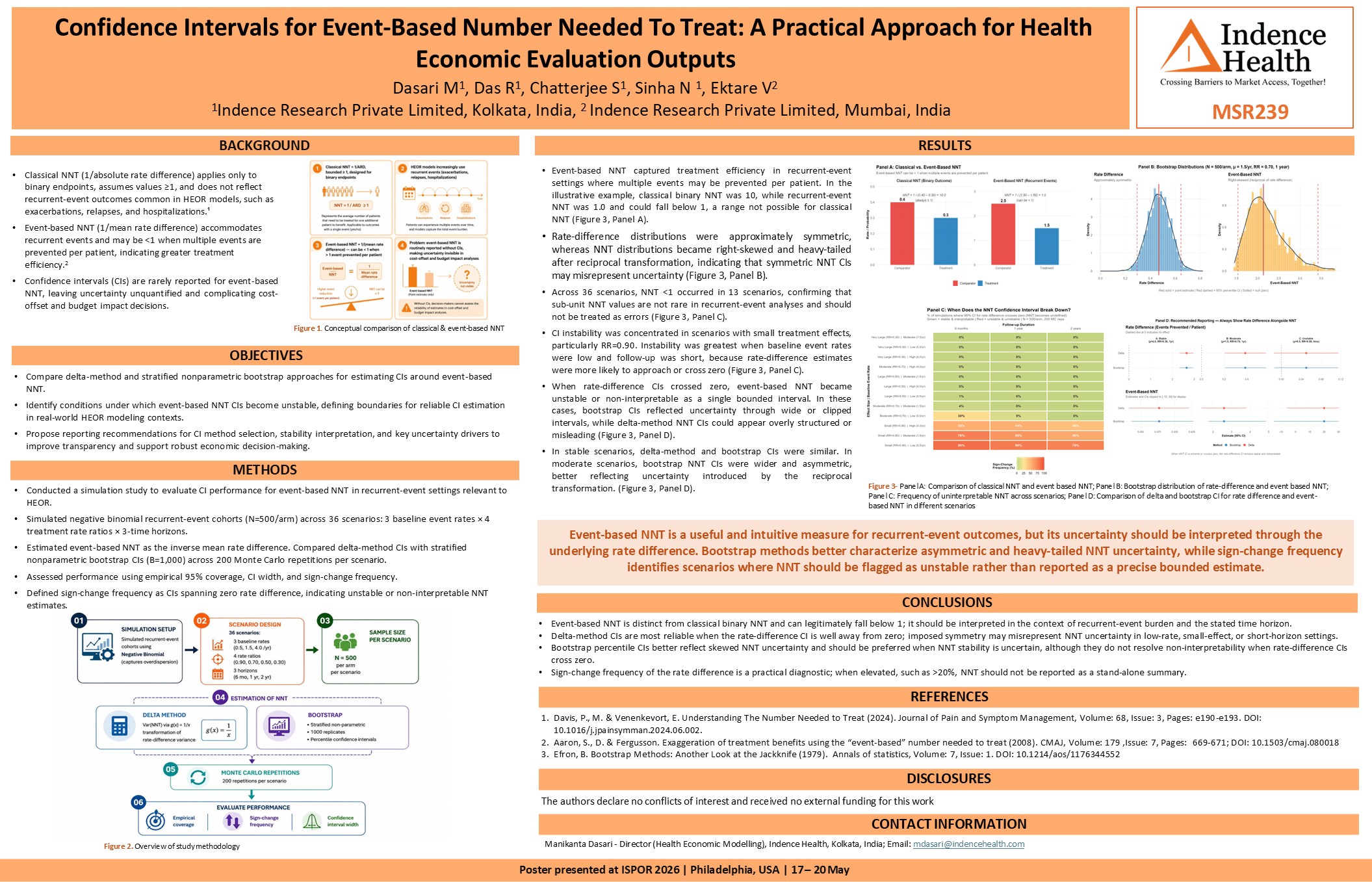


Number needed to treat is frequently used to translate treatment effects into an intuitive decision metric, but the calculation is only meaningful when it matches the structure of the endpoint. Binary outcomes, time-to-event outcomes, and recurrent events quantify treatment benefit in different units. Applying the same formula across all three can create estimates that appear simple while mixing patient-level and event-level interpretations and answering fundamentally different clinical and economic questions.
This methodological assessment compared three endpoint structures and the corresponding treatment-effect translations, with each mapped to its appropriate estimand, time horizon, and reporting unit. Fixed-time binary outcomes were expressed as patient-level number needed to treat from an absolute risk reduction. Survival outcomes required an explicitly time-specific number needed to treat based on the risk difference at a defined horizon. Recurrent-event outcomes were expressed primarily as events avoided per patient over a defined period or patient-time, with event-based number needed to treat interpreted as the reciprocal of the event-rate difference rather than as a literal patient count. Illustrative applications showed that events avoided, cost per event avoided, and resulting budget impact changed when endpoint structure and estimand were changed. For recurrent outcomes, event-based number needed to treat could legitimately fall below 1, indicating that more than one event was prevented per treated patient over the specified time horizon rather than that fewer than one patient required treatment.
The added value is a unit-consistency framework that links endpoint structure, estimand, time horizon, and reporting unit before treatment effects are translated into economic outcomes. It separates three metrics that are often treated as interchangeable and links each to the question it can validly answer. This matters because an endpoint mismatch does not stop at the clinical metric. It can propagate into cost-per-event-avoided calculations and budget impact estimates when patient-level and event-level quantities are combined inconsistently. Clear alignment of endpoint, estimand, time horizon, and reporting unit can therefore improve interpretation and strengthen the validity of downstream health economic outputs.