

Managed-entry agreements are used when a promising health technology reaches reimbursement decision-making with unresolved financial, clinical, or implementation uncertainty. Across jurisdictions, however, these arrangements are described and implemented in different ways. A list of agreement names is therefore less useful to decision-makers than an understanding of which uncertainty or risk each agreement is intended to manage, the circumstances in which it may be appropriate, and the infrastructure required to make it work.
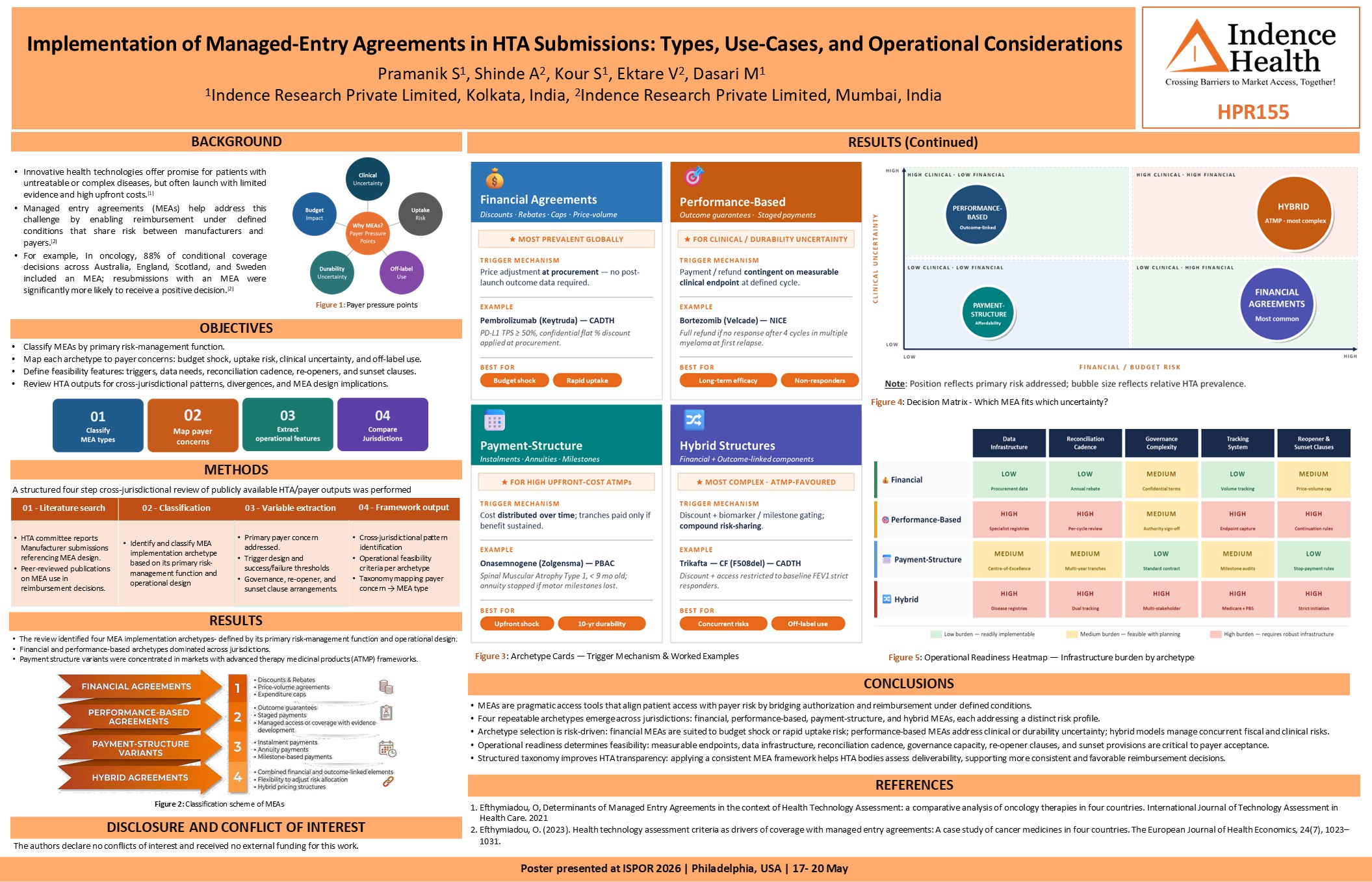
This cross-jurisdictional review examined publicly available health technology assessment submissions, and payer materials and organized managed-entry agreements according to their primary risk-management function and operational design. Four recurring archetypes emerged – financial agreements, performance-based agreements, payment-structure agreements, and hybrid agreements. Financial agreements were primarily used to manage budgetary or price-related uncertainty, performance-based agreements addressed uncertainty in real-world clinical outcomes, and payment-structure agreements addressed the timing or distribution of expenditure. Financial and performance-based approaches predominated, while payment-structure variants were more concentrated in markets with frameworks for advanced therapy medicinal products. The analysis also identified implementation requirements including measurable triggers, data availability, reconciliation cadence, governance arrangements, re-opener provisions, and sunset clauses.
The added value of the work is the translation of heterogeneous reimbursement arrangements into a practical decision framework. Instead of asking only which agreement type has been used elsewhere, the framework starts with the specific uncertainty or implementation risk that needs to be managed, links that risk to a suitable agreement design, and then considers whether the necessary operational infrastructure exists. This risk-to-design mapping can make managed-entry agreement discussions more transparent and helps distinguish an arrangement that is conceptually attractive from one that can realistically be monitored, reconciled, and governed in practice.