


Indence Publication
An introduction to Financial toxicity
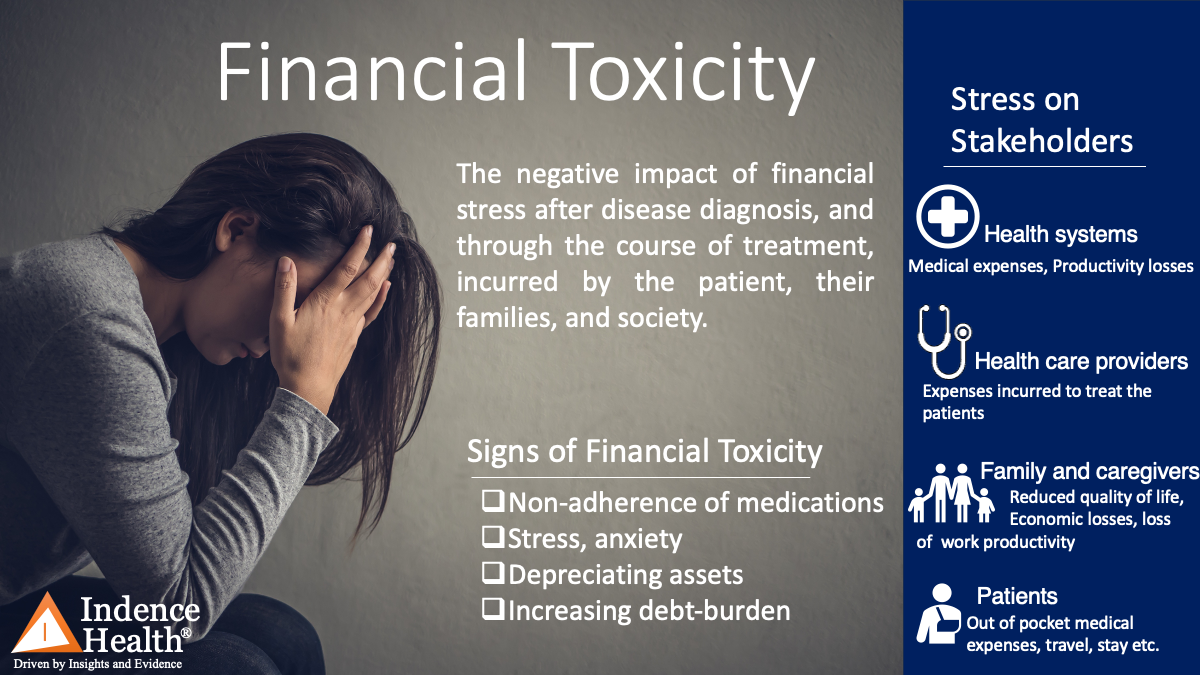
The term ‘Financial toxicity’ refers to the impacts of increasing healthcare costs and financial burden on patients, after they are diagnosed with a threatening disease. Financial toxicity was initially coined in the context of cancer patients, where not only it was used to indicate the financial hardship experienced by the patients during the treatment, but also to indicate the emotional strain and unhealthy coping mechanisms. Under financial stress, every household adjusts differently. Majority of families sell off their assets to meet the out-of-pocket expenses (OOPE), others may skip taking medication or avoid visiting the clinic. Some patients or their family members might take loans to pay for the treatment. Eventually, it becomes very stressful for the patients to make the ends meet, and which may trigger symptoms of anxiety and stress. It is important to recognize these early signs of financial toxicity. According to a recently published article by Prinja et al., (2023); the odds of impoverishment due to high OOPE were six times higher for cancer treatment than that due to infectious diseases in India. Based on the disease and other criteria, including socio-economic situations, it is comparatively simpler to identify the patients who are susceptible to financial toxicity, and appropriate measures can be adopted in due course. Financial toxicity can be broadly conceptualised under two components: (a) Objective measures: These includes direct (increased out-of-pocket expenses) and indirect (loss of personal finances) costs. (b) Subjective measures: These includes two major domains, patient-reported psychological response (distress, anxiety, and material responses), and coping strategies (non-adherence and support seeking). Multiple tools or questionnaires are used to measure financial toxicity, and a majority of these tools try to utilize either objective or subjective measures. The Comprehensive Score for Financial Toxicity (COST) questionnaire is a widely used tool to measure financial distress and economic hardships. There are other available tools which are used to measure different aspects of financial toxicity. 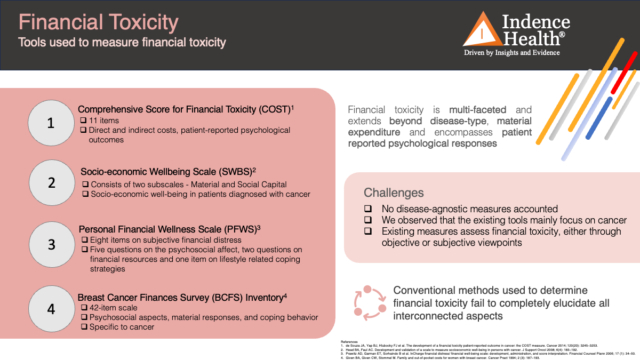 However, a majority of tools focus on cancer. These tools fall under the purview of either objective or subjective viewpoints, and do not consider both – which is an underlying challenge. We believe that one should consider both, objective and subjective measures in order to provide a holistic estimate of treatment associated financial toxicity. Why existing approaches are not enough? Financial toxicity can be measured using either objective or subjective measures. The subjective component is often nuanced, and requires in-depth understanding of underlying inter-connected domains. In our experience, very few studies have measured financial toxicity using both components. The rationale for a new concept to determine financial toxicity In order to accurately estimate the financial toxicity associated with the disease, it is necessary to adopt a holistic approach to seamlessly integrate both components. The DIPC framework
 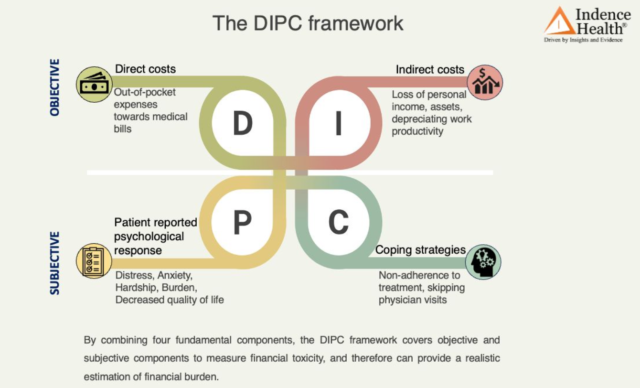 This framework combines fundamental components Indence has therefore conceptualized the DIPC framework: D: Direct costs I: Indirect costs P: Patient reported psychological response C: Coping strategies By utilizing all four critical components, this framework can assist in estimating the financial burden in a realistic manner. The DIPC framework is meant to be served as a concept for researchers, health care professionals, policy makers, industry partners and other stakeholders. Accurate estimation of financial toxicity can not only assist healthcare policy-makers, but also can provide a competitive advantage in case of pricing, market-access, especially in countries where patients are more vulnerable to the detrimental effects of financial toxicity. #Financialtoxicity #healtheconomics #diseaseburden #financialhardship#Indence
Need evidence support for a healthcare decision?
Indence Health supports evidence synthesis, health economic modelling, real-world evidence and market access communication for medical and commercial teams.