

Cell and gene therapies can create a distinctive financing problem. Costs may be concentrated at treatment initiation while clinical benefits extend over several years. Conventional budget impact models can describe expenditure, but a single fixed payment assumption may obscure how financing design itself changes the timing of affordability pressures. This work addressed that problem by making alternative payment structures an explicit, testable part of the model.
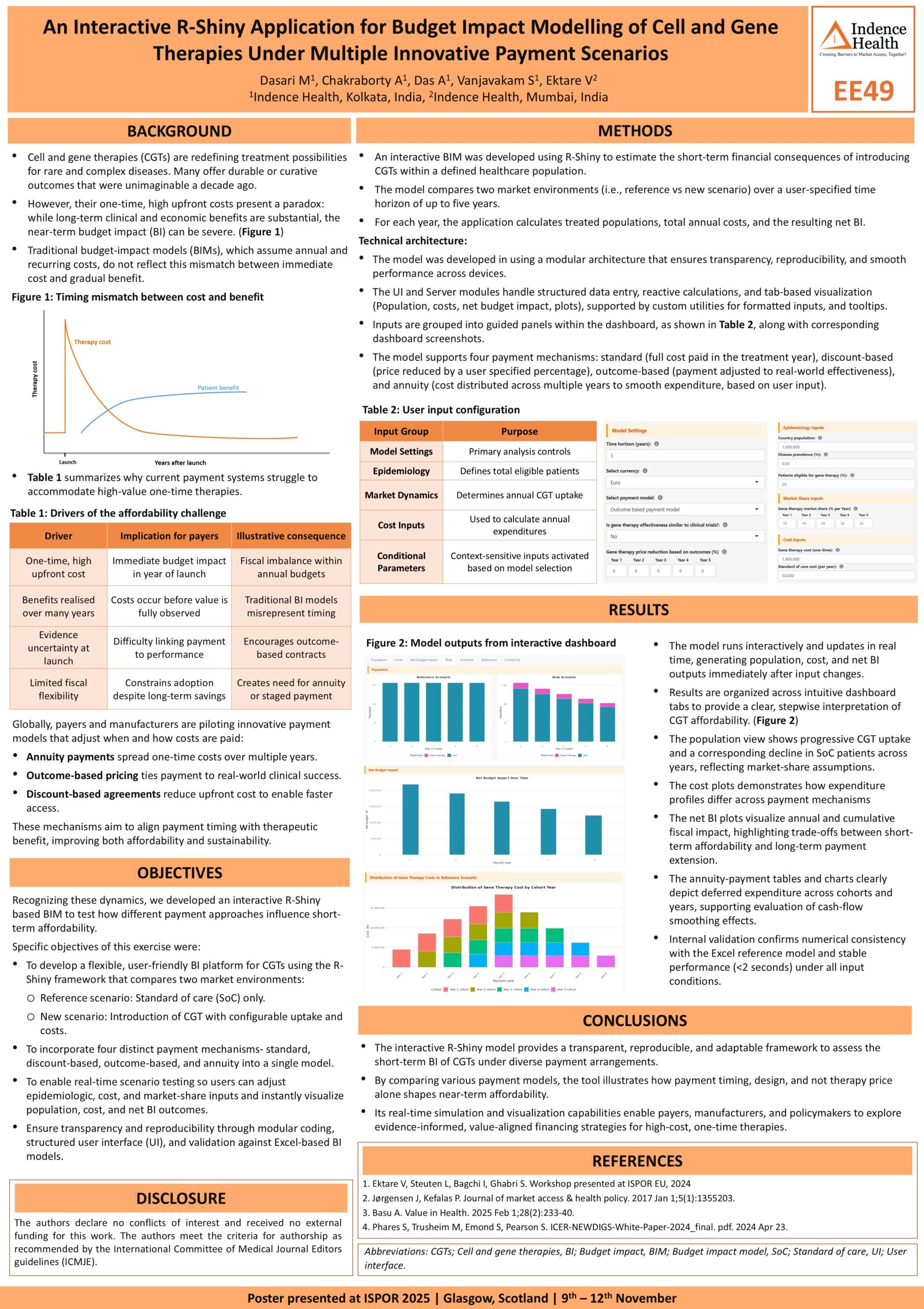
An interactive R-Shiny-based budget impact model was developed to compare a reference market containing standard of care with a new market in which a cell or gene therapy is introduced. Users can vary epidemiology, uptake, costs, and a time horizon of up to five years. Four payment mechanisms are incorporated within the same framework – standard payment, discount-based payment, outcome-based payment, and annuity payment. Users can interactively modify model inputs and compare financing scenarios, with the application updating treated populations, annual costs, and net budget impact in real time. Internal validation showed numerical consistency with the reference spreadsheet model together with stable performance across tested input conditions.
The added value is not a single budget impact estimate. The application creates a controlled environment in which the same therapy can be assessed under different financing structures, allowing the effect of payment timing and contract design to be distinguished from other drivers of budget impact, including therapy price. This turns budget impact modeling from a static calculation into an interactive scenario-testing framework and can support more transparent discussion of short-term affordability, deferred expenditure, and the trade-offs created by alternative payment arrangements for high-cost one-time therapies.