

Healthcare decisions increasingly need to account for environmental consequences as well as clinical outcomes and costs. Yet carbon emissions do not fit automatically into conventional cost-effectiveness or budget impact frameworks. The central methodological problem is therefore not whether emissions can be measured, but how environmental measures should be incorporated without obscuring the economic and health outcomes that decision-makers already use. Different approaches to integration may also be more appropriate for different decision contexts, making the choice of metric itself an important methodological consideration.
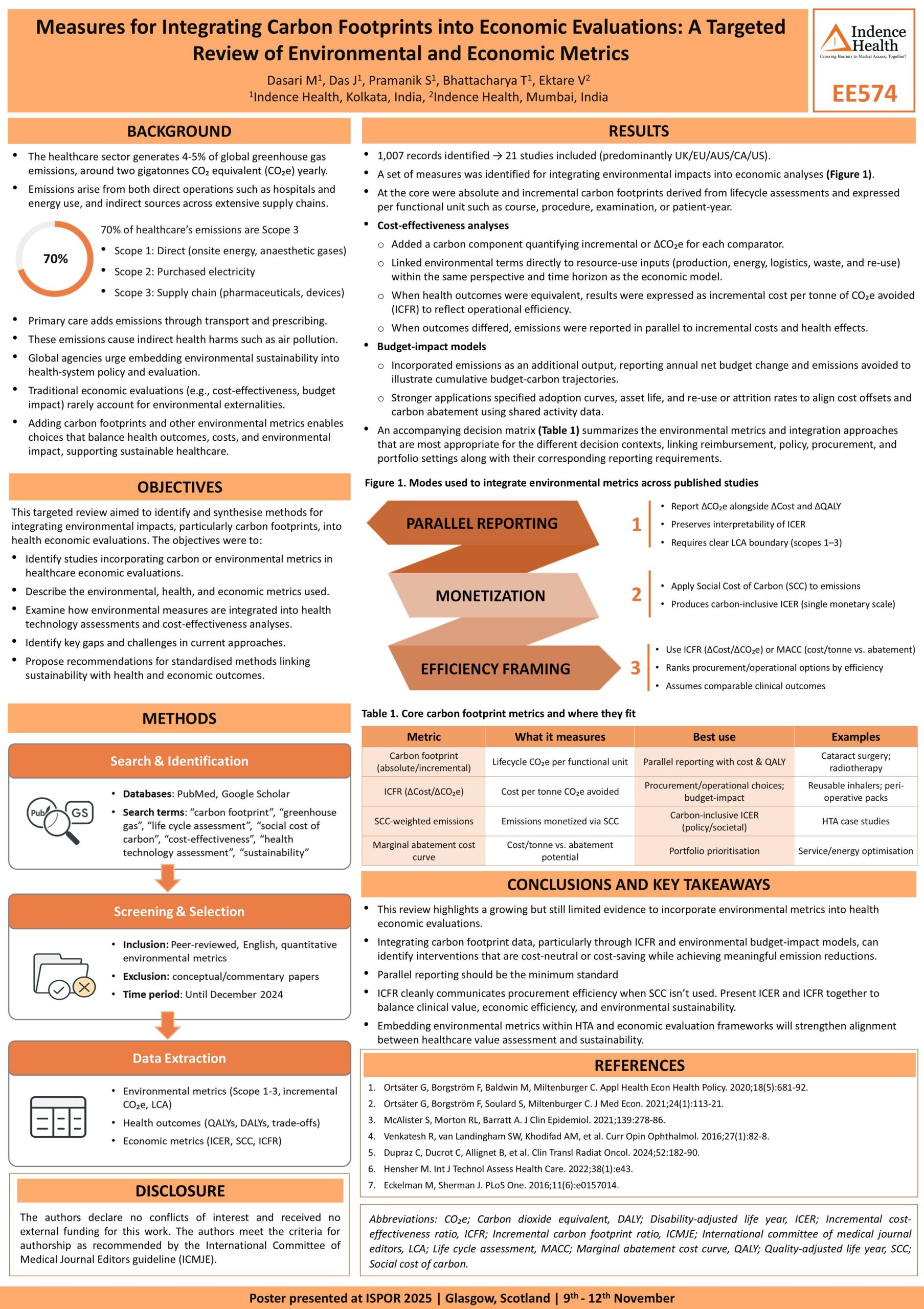
This targeted review screened 1,007 records and included 21 publications. Across the evidence base, environmental measures such as absolute and incremental carbon footprints were commonly derived from life-cycle assessments and expressed per functional unit, such as a procedure, treatment course, examination, or patient-year. The review identified several methods for integrating these environmental measures into economic evaluation and decision-making. These included parallel reporting of incremental carbon dioxide equivalent emissions alongside costs and health outcomes, incremental cost per tonne of carbon dioxide equivalent avoided when clinical outcomes are comparable, monetization of emissions using the social cost of carbon, and marginal abatement cost approaches for portfolio or operational prioritization. Environmental outputs were also incorporated into budget impact analyses to show annual financial and emissions trajectories together.
The added value of the review is a decision-oriented map of methods rather than a simple inventory of carbon estimates. By linking different environmental metrics and integration approaches to reimbursement, procurement, policy, and portfolio questions, it clarifies that no single carbon measure is suitable for every economic decision. The synthesis also identifies parallel reporting of environmental, cost, and health outcomes as a practical baseline approach while showing where more integrated approaches, such as carbon monetization or marginal abatement analysis, may provide additional decision value when the decision context and data support them.