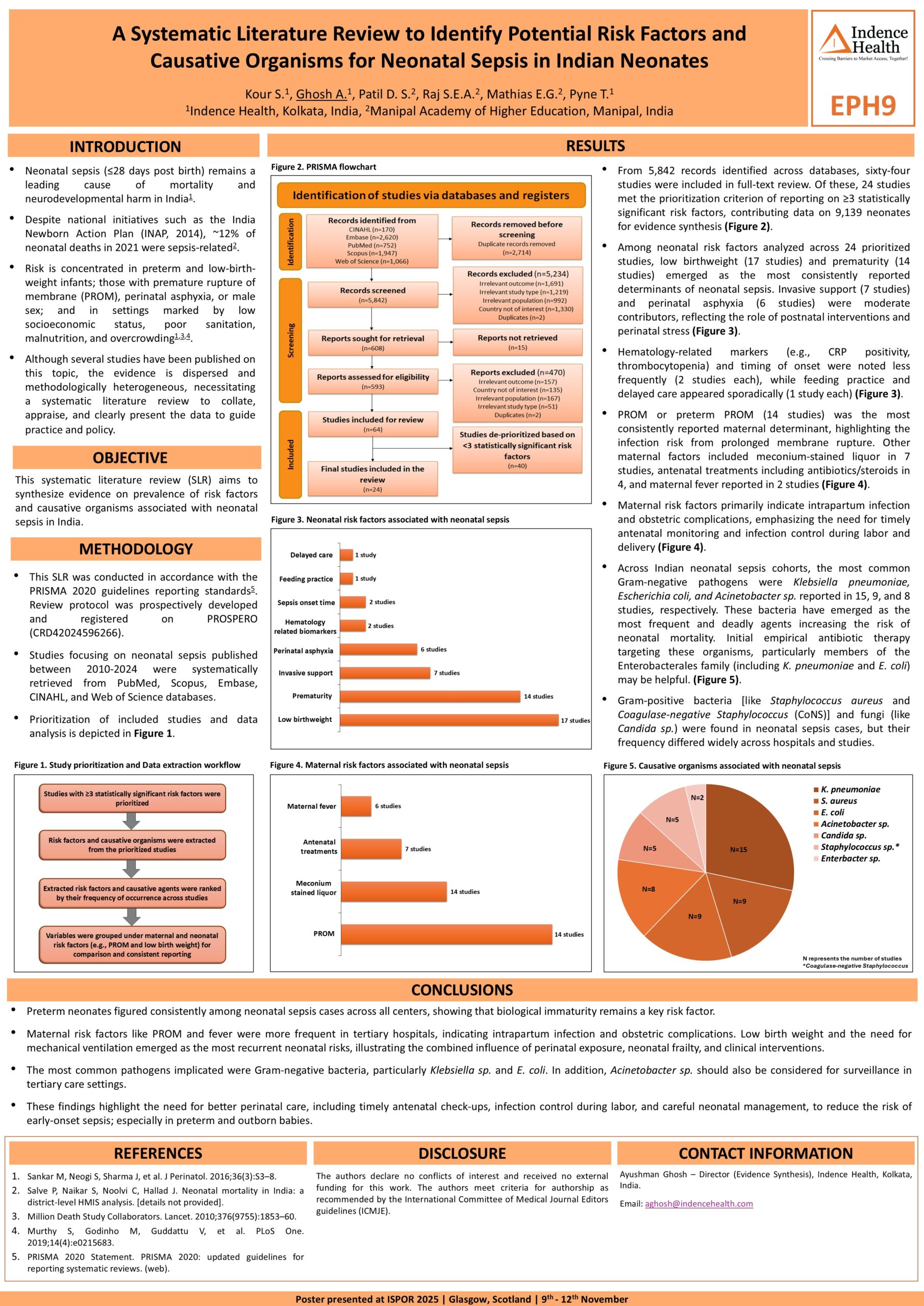


A Systematic Literature Review to Identify Potential Risk Factors and Causative Organisms for Neonatal Sepsis in Indian Neonates
Neonatal sepsis remains a major clinical and health-system challenge in India, but the evidence describing who is most at risk and which organisms are most frequently implicated is dispersed across populations, hospitals, and research designs. While individual publications can identify local risk factors or microbiological patterns, a systematic synthesis can determine which signals recur across settings and which appear only sporadically.
The review identified 5,842 records and included 64 publications at full-text review. Twenty-four publications met the pre-specified prioritization criterion of reporting at least three statistically significant risk factors, contributing data from 9,139 neonates to the focused evidence synthesis. Low birth weight and premature birth were the most consistently reported neonatal determinants, appearing in 17 and 14 prioritized publications, respectively. Premature or preterm rupture of membranes was the most frequently reported maternal determinant, appearing in 14 publications. Across Indian cohorts, Klebsiella pneumoniae, Escherichia coli, and Acinetobacter spp. were the most frequently reported Gram-negative organisms, appearing in 15, 9, and 8 publications, respectively.
The secondary value of the review is the structure it brings to a heterogeneous evidence base. Rather than treating each risk factor or organism as an isolated finding, the synthesis distinguishes recurrent determinants from less consistently reported signals and places maternal, neonatal, and microbiological evidence within the same framework. This can help direct future surveillance, prevention research, and evidence generation toward the factors that repeatedly emerge across Indian neonatal sepsis publications while also highlighting where local variation remains important.